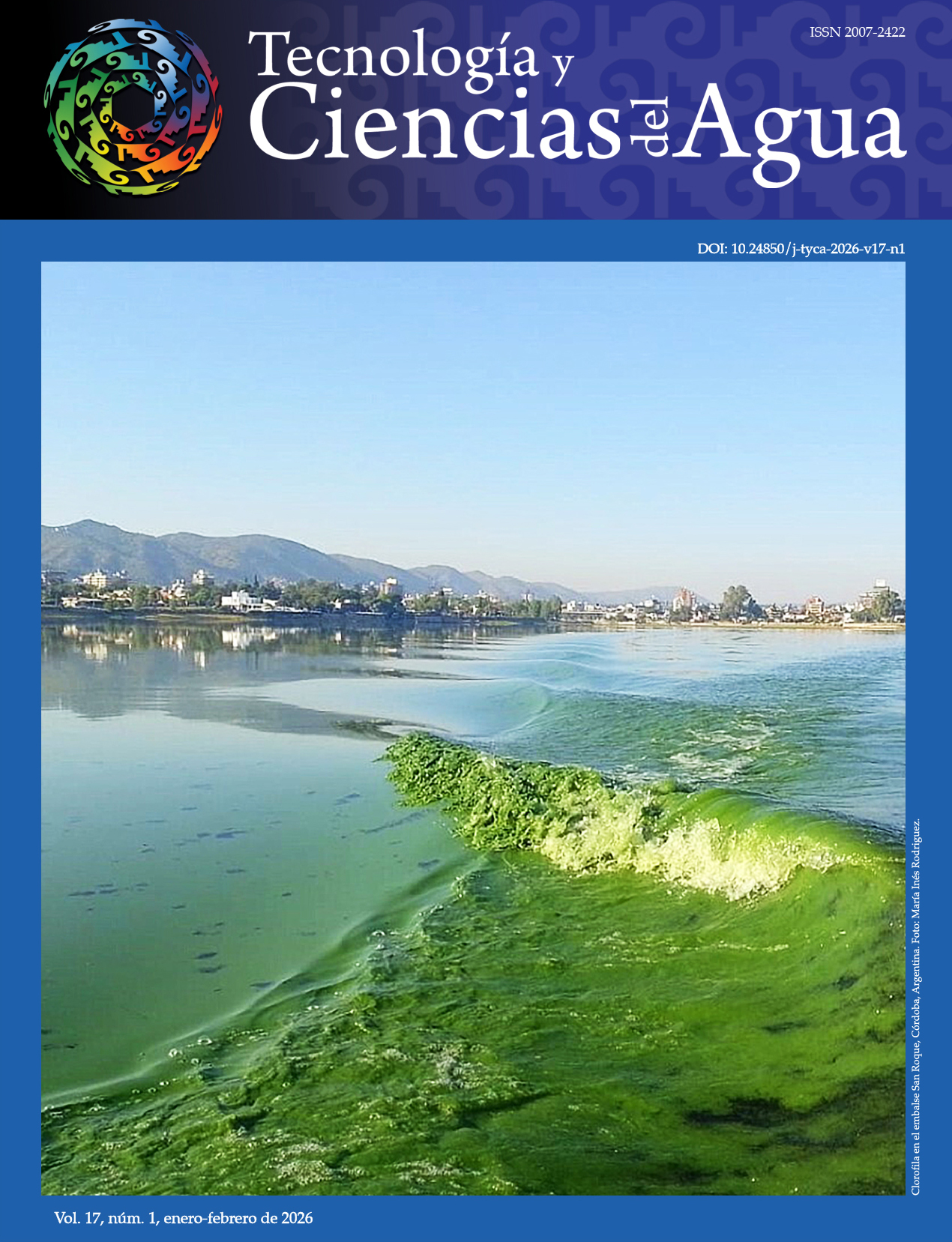
Valoración de índices de clorofila con datos Sentinel-2 en el embalse San Roque, Córdoba, Argentina
DOI:
https://doi.org/10.24850/j-tyca-2026-01-10Palabras clave:
Sentinel-2, Clorofila-a, Cl-a, NDCI, NDVI, GCI, RCl, GEE, embalse San Roque, ArgentinaResumen
En este estudio se utilizaron índices específicos con productos de Sentinel-2, procesados con Google Earth Engine (GEE), para estimar la concentración de clorofila-a (Cl-a) en el embalse San Roque, Córdoba, Argentina. Los índices específicos evaluados fueron el índice de clorofila de diferencia normalizada (NDCI), índice de vegetación de diferencia normalizada (NDVI), índice de clorofila en banda verde (GCI) e índice de clorofila en banda roja (RCl).
El índice NDCI ha demostrado ser la mejor opción entre los cuatro índices específicos evaluados, al proporcionar un ajuste con coeficiente de determinación (R²) cercano a 0.8 y estadísticamente significativo respecto a valores medidos de Cl-a, y que representa de forma adecuada la dinámica espacial y temporal de los valores medidos de Cl-a. Aplicar este índice significaría mejoras en las herramientas de gestiones actuales para este importante cuerpo de agua provincial.
Referencias
Ambrose-Igho, G. (2019). Spatiotemporal analysis of lake water quality indicators on small lakes, Lake Bloomington and Evergreen Lake in Central Illinois, using satellite remote sensing (tesis de maestría). Illinois State University, USA. Recuperado de https://ir.library.illinoisstate.edu/etd/1190
Barraza-Moraga, F., Alcayaga, H., Pizarro, A., Félez-Bernal, J. & Urrutia, R. (2022). Estimation of chlorophyll. A concentrations in Lanalhue Lake using Sentinel-2 MSI satellite images. Remote Sensing, 14(22), 5647. DOI: https://doi.org/10.3390/rs14225647
Bazán, R., Corral, M., Pagot, M., Rodriguez, A., Oroná, C., Rodriguez, M. I., Larrosa, N., Cossavella, A., Del-Olmo, S., Bonfanti, E., & Busso, F. (2005). Teledetección y modelado numérico para el análisis de la calidad de agua del embalse Los Molinos, Córdoba, Argentina. Ingeniería hidráulica en México, 20(2), 122-135.
Bramich, J., Bolch, C. J. S., & Fischer, A. (2021). Improved red-edge chlorophyll-a detection for Sentinel-2. Ecological Indicators, 120, 106876. DOI: https://doi.org/10.1016/j.ecolind.2020.106876
Caballero, I., & Navarro, G. (2021). Monitoring cyanoHABs and water quality in Laguna Lake (Philippines) with Sentinel-2 satellites during the 2020 Pacific typhoon season. Science of the Total Environment, 788, 147700. DOI: https://doi.org/10.1016/j.scitotenv.2021.147700
Chawla, L., Karthikeyan, L., & Mishra, A. K. (2020). A review of remote sensing applications for water security: Quantity, quality, and extremes. Journal of Hydrology, 585, 124826. DOI: https://doi.org/10.1016/j.jhydrol.2020.124826
ESA. (2025). Sentinel-2 user guide. Recuperado de https://sentinel.esa.int/web/sentinel/user-guides/sentinel-2-msi
GEMS/WATER, Global Environment Monitoring System/Water. (1992). Operational guide. Recuperado de https://iris.who.int/bitstream/handle/10665/62446/GEMS_W_92.1(part1).pdf;jsessionid=074E13AFA5FA576FAB3C8EA729C16681?sequence=1
German, A., Shimoni, M., Beltramone, G., & Rodríguez, M. I. (2021). Space-time monitoring of water quality in an eutrophic reservoir using SENTINEL-2 data: A case study of San Roque, Argentina. Remote Sensing Applications: Society and Environment, 24 (8), 100614. DOI: https://doi.org/10.1016/j.rsase.2021.100614
Gilabert, M. A., González-Piqueras, J., & García-Haro, J. (1997). Acerca de los índices de vegetación. Revista de teledetección. Asociación Española de Teledetección, 8, 1-10. Recuperado de https://www.researchgate.net/publication/39195330
Gilerson, A. A., Gitelson, A. A., Zhou, J., Gurlin, D., Moses, W., Ioannou, I., & Ahmed, S. A. (2010). Algorithms for remote estimation of chlorophyll-a in coastal and inland waters using red and near-infrared bands. Optics Express, 18(23), 24109-24125. DOI: https://doi.org/10.1364/OE.18.024109
Gitelson, A. A., & Yacobi, Y. Z. (1995). Reflectance in the red and near-infrared ranges of the spectrum as a tool for remote chlorophyll estimation in inland waters—Lake Kinneret case study. In: Proceedings of the Eighteenth Convention of Electrical and Electronics Engineers in Israel (IEEE). 5.2.6, 1-5. DOI: https://doi.org/10.1109/EEIS.1995.514184
Gitelson, A. A., Dall'Olmo, G., Moses, W., Rundquist, D. C., Barrow, T., Fisher, T. R., Gurlin, D., & Holz, J. (2008). A simple semi-analytical model for remote estimation of chlorophyll-a in turbid waters: Validation. Remote Sensing of Environment, 112(9), 3582-3593. DOI: https://doi.org/10.1016/j.rse.2008.04.015
GEE, Google Earth Engine. (2022). Google Earth Engine: A planetary-scale platform for Earth science data & analysis. Recuperado de https://earthengine.google.com
Ha, N. T. T., Thao, N. T. P., Koike, K., & Nhuan, M. T. (2017). Selecting the best band ratio to estimate chlorophyll-a concentration in a tropical freshwater lake using Sentinel-2A images: A case study of Lake Ba Be (Northern Vietnam). ISPRS International Journal of Geo-Information, 6(9), 290. DOI: https://doi.org/10.3390/ijgi6090290
INA & CIRSA, Instituto Nacional de Agua & Centro de Investigación de la Región Semiárida. (2024). Informe mensual de monitoreo embalse San Roque. Córdoba, Argentina: Instituto Nacional de Agua.
Kislik, C., Dronova, I., Grantham, T. E., & Kelly, M. (2022). Mapping algal bloom dynamics in small reservoirs using Sentinel-2 imagery in Google Earth Engine. Ecological Indicators, 140, 109041. DOI: https://doi.org/10.1016/j.ecolind.2022.109041
Legates, D. R., & McCabe, G. J. (1999). Evaluating the use of ‘goodness‐of‐fit’ measures in hydrologic and hydroclimatic model validation. Water Resources Research, 35(1), 233-241. DOI: https://doi.org/10.1029/1998WR900018
Li, P., Hao, F., Wu, H., & Nie, H. (2024). Spatiotemporal dynamic analysis of eutrophication status based on machine learning-based retrieval algorithm: Case study in Liangzi Lake, Hubei, China. Remote Sensing, 16(22), 4192. DOI: https://doi.org/10.3390/rs16224192
Li, R., & Li, J. (2004). Satellite remote sensing technology for lake water clarity monitoring: an overview. Environmental Informatics Archives, 2, 893-901. Recuperado de https://citeseerx.ist.psu.edu/document?repid=rep1&type=pdf&doi=0bfa92c75e3b3c676af431b21c611a51a8714046
Li, N., Martin, A., & Estival, R. (2017). An automatic water detection approach based on Dempster-Shafer theory for multi spectral images. In: 2017 20th International Conference on Information Fusion (Fusion) (pp. 1-8). Xi'an, China: Institute of Electrical and Electronics Engineers. DOI: https://doi.org/10.23919/ICIF.2017.8009789
Liu, H., Li, Q., Shi, T., Hu, S., Wu, G. & Zhou, Q. (2017). Application of Sentinel 2 MSI images to retrieve suspended particulate matter concentrations in Poyang Lake. Remote Sensing, 9, 761-780. DOI: https://doi.org/10.3390/rs9070761
Maier, P. M., & Keller, S. (2019). Application of different simulated spectral data and machine learning to estimate the chlorophyll-a concentration of several inland waters. In: 10th Workshop on Hyperspectral Imaging and Signal Processing: Evolution in Remote Sensing (WHISPERS). Amsterdam, Netherlands: Institute of Electrical and Electronics Engineers (IEEE). DOI: https://doi.org/10.1109/WHISPERS.2019.8921073
Mishra, S., & Mishra, D. R. (2012). Normalized difference chlorophyll index: A novel model for remote estimation of chlorophyll-a concentration in turbid productive waters. Remote Sensing of Environment, 117, 394-406. DOI: https://doi.org/10.1016/j.rse.2011.10.016
Muchiut, J., Rodríguez, M. I., Ruibal-Conti, A. L., Ruiz, M., & Rodriguez, A. (2024). Numerical modeling of the influence of reservoir management on the algal blooms of San Roque. International Journal of Environmental Science and Technology, 21, 1083-1098. DOI: https://doi.org/10.1007/s13762-023-05102-5
Pagot, M., Rodriguez, A., Hillman, G., Corral, M., & Niencheski, F. (2007). Remote sensing assessment of suspended matter and dynamics in Patos Lagoon. Journal of Coastal Research, 47(1), 115-129. DOI: https://doi.org/10.2112/1551-5036-47.sp1.116
Palmer, S. C. J., Hunter, P. D., Lankester, T., Hubbard, S., Spyrakos, E., Tyler, A. N., Présing, M., Horváth, H., Lamb, A., Balzter, H., & Tóth, V. R. (2015). Validation of Envisat MERIS algorithms for chlorophyll retrieval in a large, turbid and optically-complex shallow lake. Remote Sensing of Environment, 157, 158-169. DOI: https://doi.org/10.1016/j.rse.2014.07.024
Ponce, G. A., Rodríguez, M. I., Ruibal-Conti, A. L., Muchiut, J., & Rodríguez, A. (2023) Aplicación preliminar del modelo MIKE 21 en un embalse eutrófico durante eventos de crecidas: caso embalse San Roque, Argentina. Tecnología y ciencias del agua, 14(3), 314-364. DOI: https://doi.org/10.24850/j-tyca-14-03-07
QGIS.org. (2025). QGIS Geographic Information System. QGIS Association (3.28.10). Recuperado de http://www.qgis.org
Richardson, L. L. (1996). Remote sensing of algal bloom dynamics. BioScience, 46(7), 492-501. DOI: https://doi.org/10.2307/1312927
Wackerly, D., Mendenhall III, W., & Scheaffer, R. (2008). Mathematical statistics with applications (7th ed.). Belmont, USA: Thomson Brooks/Cole.
Xu, M., Liu, H., Beck, R., Lekki, J., Yang, B., Shu, S., Kang, E. L., Anderson, R., Johansen, R., Emery, E., Reif, M., & Benko, T. (2019). A spectral space partition guided ensemble method for retrieving chlorophyll-a concentration in inland waters from Sentinel-2A satellite imagery. Journal of Great Lakes Research, 45(3), 454-465. DOI: https://doi.org/10.1016/j.jglr.2018.09.002
Yu, S., Bai, Y., He, X., Gong, F., & Li, T. (2023). A new merged dataset of global ocean chlorophyll-a concentration for better trend detection. Frontiers in Marine Science, (10). DOI: https://doi.org/10.3389/fmars.2023.1051619
Zhang, Q., Yuan, Q., Zeng, C., Li, X., & Wei, Y. (2018). Missing data reconstruction in remote sensing image with a unified spatial-temporal-spectral deep convolutional neural network. IEEE Transactions on Geoscience and Remote Sensing, 56 (8), 4274-4288. DOI: https://doi.org/10.1109/TGRS.2018.2810208
Descargas
Publicado
Número
Sección
Licencia
Derechos de autor 2026 Tecnología y ciencias del agua

Esta obra está bajo una licencia internacional Creative Commons Atribución-NoComercial-CompartirIgual 4.0.
Por Instituto Mexicano de Tecnología del Agua se distribuye bajo una Licencia Creative Commons Atribución-NoComercial-CompartirIgual 4.0 Internacional. Basada en una obra en https://www.revistatyca.org.mx/. Permisos que vayan más allá de lo cubierto por esta licencia pueden encontrarse en Política editorial